
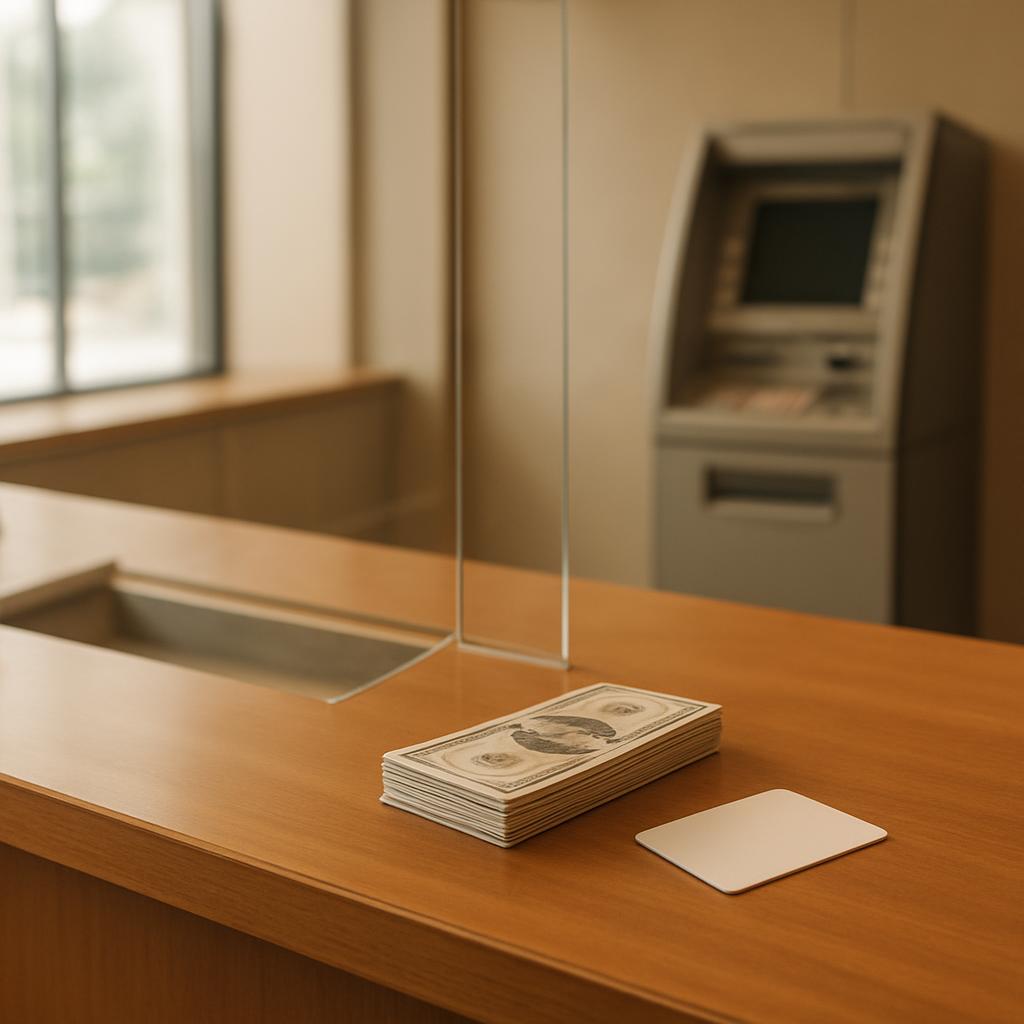
In card payments, a cash disbursement is cash handed over the counter by a bank or other financial institution against a payment card, while a cash withdrawal usually means cash taken from an ATM. Card networks classify the two separately: teller-assisted cash is coded as a manual cash disbursement and ATM cash as an automated cash disbursement. For the person holding the card, the bigger difference is the type of card used. Taking cash on a debit card simply moves your own money, while taking cash on a credit card, by either route, is a cash advance with an upfront fee and interest from the first day.
Key takeaways
- Card networks use merchant category code 6010 for manual cash disbursements at a bank counter and 6011 for automated cash disbursements at ATMs.
- On a debit card, both are simply withdrawals from your own account, usually free at your bank's own ATMs and branches.
- On a credit card, both are cash advances: most major issuers charge 5% or $10, whichever is higher, plus interest from day one.
- Some purchases, such as money orders, foreign currency and certain transfers, are coded as quasi-cash and can be treated as cash advances too.
- Cash back at a shop checkout is different again: it is added to a debit card purchase and is not usually charged as a cash advance.
What is a cash disbursement?
A cash disbursement is any transaction in which a financial institution pays out cash to a cardholder against a payment card. In everyday use the term most often refers to a manual cash disbursement: you walk up to a bank teller, hand over a debit or credit card and identification, and the teller authorizes the transaction through the card network before giving you the money.
The card networks give this its own merchant category code, 6010, described in network listings as Financial Institutions, Manual Cash Disbursements. Payment provider PXP describes MCC 6010 as covering teller-assisted withdrawals at bank counters, which Visa and Mastercard treat as cash advance transactions, and where issuers may impose daily limits. Because the teller checks your identity in person, a manual disbursement is often the way to get a larger amount of cash than an ATM will allow.
What is a cash withdrawal?
A cash withdrawal, in common use, means taking money out of an ATM with your card and PIN. The card networks call this an automated cash disbursement and code it as MCC 6011. Behind the scenes the ATM owner sends the request through the card network to your bank, which checks your balance or available credit and approves or declines it, much like any other card transaction.
The terms overlap, which is where the confusion comes from. Banks often describe any removal of money from your own account, at an ATM or a branch counter, as a withdrawal. Card networks and card agreements, on the other hand, talk about cash disbursements because the card, not the account, is what triggers the payout. When you see either word on a statement, the code and the type of card tell you what was actually charged.
| Feature | Manual cash disbursement | ATM cash withdrawal |
|---|---|---|
| Where | Bank or financial institution counter | Automated teller machine |
| Network category code | 6010 | 6011 |
| How you verify | Card plus ID, sometimes a PIN | Card plus PIN |
| Typical limits | Often higher, set by the issuer and branch | Daily ATM limits set by the issuer and machine |
| On a debit card | Withdrawal from your own account | Withdrawal from your own account |
| On a credit card | Cash advance | Cash advance |
Does it matter whether you use a debit or credit card?
It matters far more than whether you use a teller or a machine. With a debit card, the cash comes out of money you already have. Your bank may charge for using another bank's ATM, and the ATM owner may add its own surcharge, but there is no interest because you are not borrowing anything.
With a credit card, any cash you take is a loan against your credit line, known as a cash advance. As Experian explains, card companies charge a cash advance fee when you use the card's credit line to get cash instead of making a purchase, typically 3% to 5% of the amount, and the interest rate on cash advances is usually higher than the rate on purchases. A 2024 review of card agreements by the US Consumer Financial Protection Bureau found that most major issuers charge 5% or $10, whichever is more, and that around 30% a year is the most common cash advance rate, according to a summary by Money Crashers.
The other key difference is timing. Purchases normally come with a grace period, so you pay no interest if you clear your balance by the due date. Cash advances do not. Interest starts the day the transaction posts, and the cash advance limit on a card is often only a fraction of the overall credit limit. Business owners using company cards face the same rules, which is one reason our guide to business card types lists cash advance fees among the costs to check before applying.
What does a credit card cash advance actually cost?
Here is a worked example using typical terms. Suppose you take $500 in cash from an out-of-network ATM on a credit card that charges a 5% cash advance fee and a 30% cash advance APR, and you repay it in full 30 days later.
- Cash advance fee: 5% of $500 is $25, charged immediately.
- Interest: $500 at 30% a year for 30 days is about $12.33, starting from the day of the withdrawal.
- ATM fee: if the machine charges something close to the 2025 average of $4.86 reported by Chime, that is added on top.
- Total cost: roughly $42 to borrow $500 for one month, before any interest on the fee itself.
The same $500 taken from your own bank's ATM on a debit card would usually cost nothing. Taken at a bank counter on a credit card, it would cost the same cash advance fee and interest, and the bank paying out the cash may add its own fee. Paying for the same goods with the credit card as a normal purchase, then clearing the balance by the due date, would cost nothing at all.
What other transactions count as cash?
Card networks also have codes for transactions that are not cash but are treated like it, often called quasi-cash. Network listings show MCC 6050 for quasi-cash at member financial institutions and MCC 6051 for quasi-cash at non-financial merchants, covering items such as foreign currency, money orders and travelers' checks. Many credit card issuers treat these as cash advances, with the same fee and immediate interest, and some apply the same treatment to wire transfers, betting and certain digital currency purchases.
Experian notes that card companies charge cash advance fees for transfers they classify as cash advances, which is why a payment you thought was a purchase can appear on your statement as a cash advance. The merchant's category code decides it, not how the transaction felt at the checkout. If you are unsure, check your card agreement's definition of a cash advance before using a credit card for anything that resembles cash.
Is cash back at a store a cash withdrawal?
No, not in the card network sense. Cash back is cash a shop hands you on top of a debit card purchase, so the whole amount is processed as a single purchase transaction. Most banks do not charge for it, though some shops set a minimum purchase or a maximum cash-back amount, and it is generally only offered on debit cards. It is often the cheapest way to get small amounts of cash without finding an in-network ATM.
Cash back also has a security benefit over some ATMs: the card stays in a staffed, monitored terminal rather than a machine that could be fitted with a skimming device. Where an ATM is used, your PIN is protected by being encrypted inside a secure PIN block before it leaves the keypad, a process explained in our guide to PIN block formats. Stolen ATM data is also one of the patterns banks trace through common point of purchase analysis.
Where things stand in November 2026
As of November 2026, the distinctions above still apply across the major US card networks, and credit card cash advance terms remain costly. Fees of 3% to 5%, with a typical minimum of around $10, are standard, and cash advance APRs commonly sit well above purchase rates, often around 30%. Rates are variable on most cards and move with the Federal Reserve's benchmark, which the Fed's committee most recently voted to hold steady, so cash advance rates are not expected to fall sharply in the near term.
Fewer people need cash than a decade ago, as contactless and mobile wallet payments replace notes and coins for everyday spending. That has made cash advances more of a last resort than a convenience, and it is worth knowing the cheaper options before you need them: in-network ATMs on a debit card, cash back at checkout, or a bank transfer instead of cash where the recipient can accept one.
Frequently asked questions
Is a cash disbursement the same as a cash advance?
On a credit card, yes: a cash disbursement at a bank counter and an ATM withdrawal are both treated as cash advances. On a debit card, a cash disbursement is simply a withdrawal from your own account and is not a cash advance.
Why does my statement say cash disbursement instead of withdrawal?
Statements often use the card network's description of the transaction. If the cash was paid out by a teller, it may be described as a manual cash disbursement; if from an ATM, as an automated cash disbursement or withdrawal.
Does a cash advance hurt my credit score?
The cash advance itself is not reported separately, but it adds to your credit card balance and raises your credit utilization, which can lower your score until it is repaid. The fees and interest also add to the balance.
Can I avoid cash advance fees?
Use a debit card at your own bank's ATMs or branches, ask for cash back with a debit card purchase, or pay by card or bank transfer instead of using cash. Using a credit card to get cash almost always triggers the fee.
What is MCC 6010?
MCC 6010 is the merchant category code for financial institutions making manual cash disbursements, meaning cash paid out over the counter against a payment card. ATM cash uses MCC 6011.